


One Issue or All 19: Put Your Concerns in the Record
You can comment once. You can comment several times. You can focus on the one issue that matters most to you, or work through all 19 issues we have identified.
What matters is that your comments are specific, meaningful and submitted in your own words before September 30.
Forest Access For All developed 19 public issue flyers from our review of the Blue Mountains Forest Plan Revision. These issues connect to the 13 broader subjects available in FAFA’s commenting tool.
Look through the flyers below. Find the issues that affect your family, work, community or use of the forest. Then use our tool to explain your concerns and tell the Forest Service what needs to change.
FAFA’s free tool will help you build a comment in your own words:
1. Missing Supporting Information
The DEIS directed the public to supporting information that was not available. The Forest Service later called those references mistakes, but removing a reference does not replace the missing information or return the public’s lost review time.

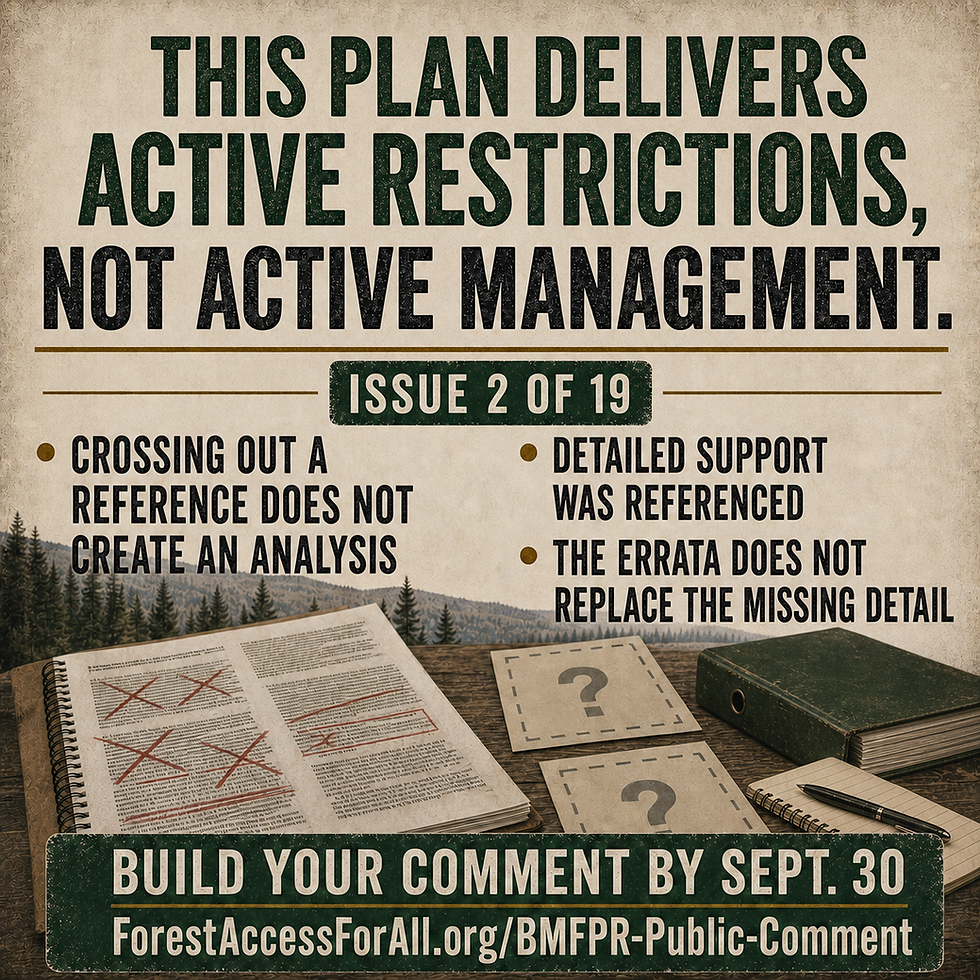
2. The Errata Does Not Create an Analysis
The agency crossed out several references through an errata. The public still needs the detailed comparisons, habitat information, assumptions and compliance analysis those references said existed.
3. Access Is Not Outside This Plan
The plan may not close a named road today, but it establishes management direction that can shape future travel-management decisions. The future rulebook is being written now.

4. Motorized Does Not Mean Access Is Protected
A Semi-Primitive Motorized label does not guarantee existing access. ROS settings can help shape later decisions about designated routes, motorized-use areas and which roads or trails remain available.

5. Streamside Rules Can Affect Access
Many roads, trails, grazing improvements and traditional-use areas follow streams or cross drainages. Riparian direction could later be used to relocate, restrict, store or decommission access without clearly showing the public what would be affected.

6. Increased Compared to What?
Alternative 2 timber output is approximately 27 percent below the combined original 1990-plan baseline. Current grazing levels are approximately 34 percent below the original 1990-plan output.

7. How Much of the Withdrawn 2018 Plan Is Back?
The public deserves to know what language, assumptions and analysis were carried forward from the withdrawn 2018 plan. The Forest Service should provide a clear comparison showing what was reused, changed or rejected.

8. A Modeled Timber Number Is Not Work on the Ground
Projected timber is not timber delivered to a local mill. It does not become jobs, county revenue, road maintenance or forest treatment unless projects are actually offered, sold and completed.

9. Paper AUMs Do Not Keep a Ranch Operating
Grazing numbers mean little if ranchers cannot reach pastures, maintain water, repair fences, use corrals or respond to fire and drought. The plan needs to analyze whether grazing remains usable on the ground.

10. Access Is Heat, Food, Family and Work
Access can mean firewood, food in the freezer, grazing, gathering, family camping areas and taking an elderly or disabled family member into the mountains. A use can remain legal on paper and still be lost when people can no longer reach it.

11. A Colored Map Is Not an Effects Analysis
The public needs to see how roads, trails, private property, grazing allotments, mining claims, timber areas and traditional uses overlap the proposed management layers. Another colored map without that information is not enough.

12. Removing a Road-Density Rule Does Not Protect Access
FAFA does not support arbitrary road-density standards. We also do not support replacing them with broader wildlife language that may give future decision-makers even more discretion to restrict access without a measurable trigger or stopping point.

13. Who Helped Shape This Plan?
The Forest Service should disclose the roles played by the Blues Intergovernmental Council, outside socioeconomic work, cooperating agencies and other organized participants. The public deserves to know who helped shape the alternatives and how their recommendations were used.

14. Removing the 21-Inch Rule Does Not Guarantee More Logging
Removing one rule does not automatically produce more active management. The public needs to know what old-growth, large-tree and project-level restrictions replace it and how those provisions affect treatment and timber output.

15. Mining and Material Access Is Not Recreation
Mining claims, gravel sources, community pits, county roads, historic routes and private inholdings support businesses, ranches, road maintenance and emergency response. Broad assurances about “reasonable access” are not enough.

16. What Is the Actual Road System Today?
Before the Forest Service can explain future access, it must show the current road and trail system. The public needs to know which routes are open, closed, stored, seasonal, administrative-only or decommissioned, and what authority supports each status.

17. What Happened to the Public’s Earlier Comments?
The Forest Service has referenced thousands of comments connected to this planning effort. The public needs to know which comments were counted, how they were coded and how they influenced the alternatives.

18. A Promise Without Measurement Is Not a Promise
The plan needs measurable monitoring for access, grazing, timber, firewood, household effects and local economic results. The public should receive a regular scorecard showing what changed, why it changed and whether promised results were delivered.

19. Restrictions Do Not Come One at a Time
The greatest problem may appear when ROS, scenery, wildlife, riparian, roadless, river and wilderness layers overlap. The Forest Service must analyze the cumulative effect instead of discussing every restriction separately.

Now It Is Your Turn
Choose one issue or choose several. You do not need to understand thousands of pages or address the entire plan in one comment.
Tell the Forest Service:
Which place, road, use or issue matters to you.
How the proposed direction could affect you.
What the DEIS failed to explain or analyze.
What needs to be changed in the final plan.
FAFA’s free tool will help you build a comment in your own words:
Comments must be submitted by September 30, 2026.
Do not comment simply to add another number. Comment to put your knowledge, experience and requested fixes into the official record.


Comments